Can You Build a Luxury Real Estate Website Without IDX?
Can a luxury real estate website work without IDX integration? Yes, here's when a manual portfolio site outperforms live MLS feeds for high-end agents.
IDX adds live MLS listings and monthly fees and slower load times. For luxury agents focused on curated presentation and relationship-led business, a non-IDX site often performs better. Here is the honest breakdown.
By Sheikh Hassaan — Website developer for service businesses
Quick Answer
Yes, a luxury real estate website can perform well without IDX integration. For agents managing a curated portfolio of high-value listings rather than a high-volume inventory, a manually maintained property portfolio built with custom post types gives full SEO control, faster load speed, lower ongoing cost, and a more distinctive presentation than a standard IDX feed. IDX is the right choice for volume-driven agents. For luxury specialists, it is often an expensive complication that damages the site's performance without adding meaningful value.
What IDX Actually Does and Why Luxury Agents Question It
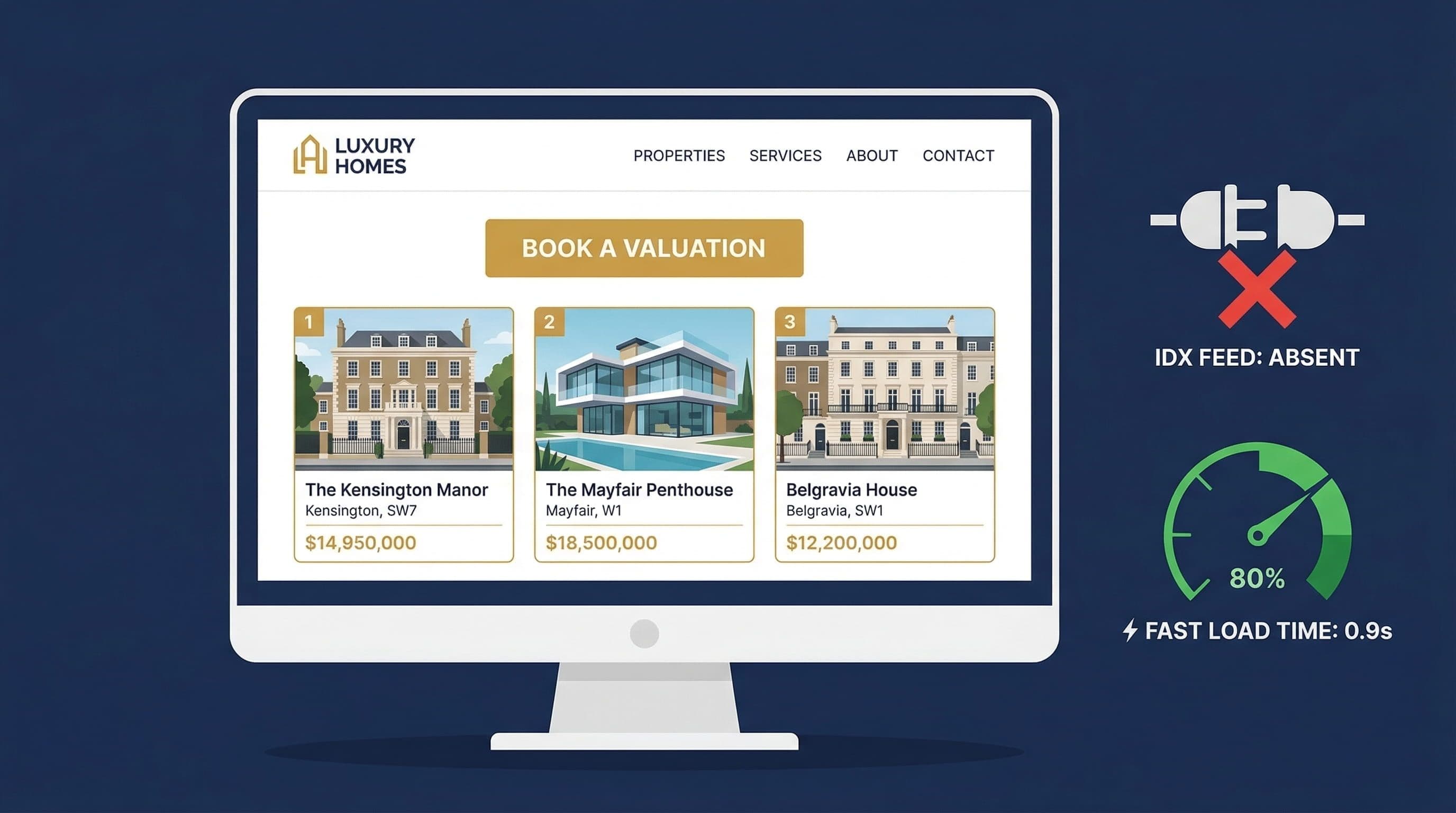
IDX, or Internet Data Exchange, connects a real estate website to the MLS database and displays live property listings pulled from the feed. For a general practice agent managing dozens of active listings across multiple price points, an IDX integration keeps the site current without manual updates.
For a luxury specialist managing three to eight high-value listings at any given time, the value proposition looks different. The IDX service costs $50 to $150 per month on top of hosting and development. It adds a third-party script or iframe to every property page that significantly increases load time. The property pages generated by IDX systems are often not indexed by Google because they are rendered dynamically from external data. The agent pays monthly, gets slower pages, and receives limited SEO benefit from the listing content.
The luxury real estate market operates on different buying behaviour than the general market. A buyer in the $2 million to $20 million price range is not searching MLS databases on an agent's website the way a first-time buyer searches the $350,000 to $500,000 range. High-net-worth buyers in the luxury segment work through agents, referrals, and private networks. They visit an agent's website to evaluate the agent, not to search a property database.
This distinction is what makes the IDX question worth examining for luxury agents specifically. The tool was designed for a different type of buyer behaviour than the luxury market typically exhibits. A site that performs better without it is not a compromised site. It is a site matched to the actual decision-making pattern of the target client.
When a Non-IDX Site Works Better for Luxury Agents
You Manage a Curated Portfolio Rather Than a Volume Inventory
A luxury agent with five to ten active listings at any given time does not need a live database feed. Those listings can be maintained as individual property pages updated manually when a property is listed, sold, or withdrawn. The manual update process takes 15 to 30 minutes per listing and gives the agent full control over how each property is presented, including custom photography choices, specific property narrative copy, and SEO-optimised page titles that a standard IDX page cannot produce.
The curated approach also creates a stronger brand impression. A gallery of five exceptional properties presented with care communicates expertise and selectivity in a way that a database of 200 mixed listings cannot. For a luxury agent whose positioning depends on being seen as a specialist in the high-end market, the curated manual portfolio is a more accurate representation of the business than an IDX feed.
Pro Insight:
Keep sold properties visible on the site as a sold portfolio section rather than removing them when they complete. A sold portfolio showing 20 high-value completed transactions over the past two years is a more powerful trust signal than any testimonial. It demonstrates track record with specificity that generic credibility copy cannot achieve.
You Want Full SEO Control Over Every Property Page
IDX property pages are generated dynamically from MLS data. The title tag, meta description, heading structure, and page copy are determined by the IDX system, not by the agent or developer. Most IDX-generated pages are thin content that Google does not index or ranks poorly. The agent pays for live listing data on pages that contribute nothing to organic search visibility.
A manually maintained property page is a standard WordPress post or custom post type with full SEO control. The title tag can include the property address, area name, and property type. The meta description can be written for the specific searcher intent. The page copy can describe the property in detail and include the local area keywords that attract the right buyer searches. These pages can rank in Google for specific property searches in a way that IDX pages almost never do.
Pro Insight:
A property page titled 'Four-Bedroom Period House for Sale in Notting Hill — Private Garden, Guide Price £3.2M' with a full property description and local area context has a realistic chance of ranking for specific high-value searches. The equivalent IDX-generated page titled 'Property ID 84721' with a data-feed description does not.
Site Speed Is a Priority in Your Market
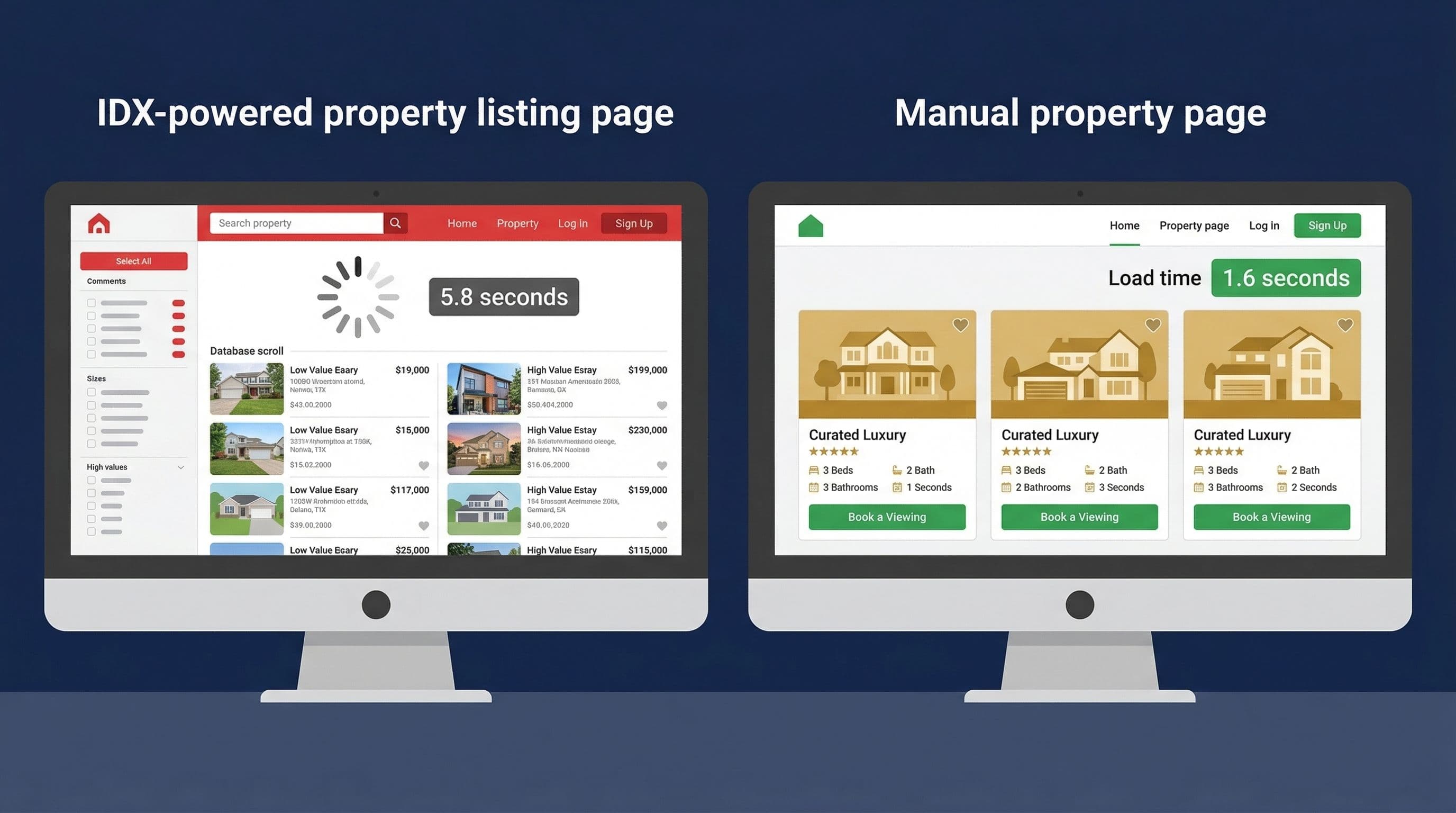
IDX integration adds significant page weight. A property page that loads an IDX iframe or JavaScript widget is loading external data from a third-party server on every page view. The performance impact ranges from 1 to 3 additional seconds of load time per page depending on the IDX provider and the visitor's connection. For a luxury real estate site where property photography already creates load time pressure, adding IDX overhead compounds the problem.
A non-IDX property page with compressed photography, lazy loading, and a quality caching configuration loads in under two seconds on mobile. That speed difference has a direct impact on how a high-net-worth client perceives the agent's digital presence. A fast, polished site signals professional competence in a way that a slow, feature-heavy site does not, regardless of how comprehensive the listing database is.
Your Business Model Is Relationship-Led, Not Search-Led
Luxury real estate transactions are primarily initiated through agent relationships, referrals, and private networks, not through property database searches. A buyer at the $5 million price point is not browsing 47 listing pages on an agent's website. They are evaluating the agent based on reputation, track record, and the quality of properties they represent.
A site built to support a relationship-led business model should centre the agent, the agent's market expertise, and the quality of the portfolio. IDX integration centres the inventory. For a luxury specialist whose competitive advantage is personal relationships and market knowledge, a site that leads with agent credibility and curated listings is a more accurate and more effective marketing tool than one that leads with a property search interface.
How to Build a High-Converting Luxury Real Estate Site Without IDX
Step 1:- Build a Curated Property Portfolio Using Custom Post Types
What to do: Register a custom post type for properties in WordPress using a plugin like Custom Post Type UI or by adding a small amount of code to the theme functions file. Each property gets its own post with custom fields for price, bedrooms, area, status (available or sold), and property type. This creates a structured property database within WordPress that can be displayed, filtered, and searched without any external IDX dependency.
Why it matters: A custom post type gives the agent a clean, maintainable way to add and update properties without needing developer involvement for each listing. The properties are stored in WordPress, load with the site's existing performance setup, and can be fully optimised for SEO on a per-page basis.
Pro Insight:
Create separate views for available and sold properties from the start. The available section is the active portfolio. The sold section becomes the track record archive that builds credibility over time. Organise sold properties by year so clients can see consistent activity across multiple periods.
Step 2:- Write SEO-Optimised Property Pages That Google Can Index
What to do: For each active listing, write a minimum of 300 words of property-specific copy covering the property description, key features, local area context, and the agent's commentary on why this property represents good value in the current market. Set the title tag to include the property type, location, and a key feature. Set the meta description to address the specific buyer searching for this type of property in this area.
Why it matters: Property pages written with real content and proper SEO structure can rank for specific high-value searches that IDX pages never capture. A detailed property page for a period house in a desirable area can attract organic traffic from buyers specifically searching for that type of property, months after the listing has been created.
Pro Insight:
Even after a property sells, the page retains SEO value. Update the status to sold and add a brief outcome note: sold in 18 days, 3% above asking price. The page continues to rank for area-specific property searches and now functions as a trust signal showing completed transactions rather than just a dead listing page.
Step 3:- Position the Site Around the Agent, Not the Inventory
What to do: Structure the site so the homepage leads with the agent's positioning statement, market expertise, and credentials before presenting the property portfolio. The homepage headline should communicate the agent's specific value, the primary market served, and the client type targeted. The property portfolio is presented as evidence of expertise, not as the primary service being offered.
Why it matters: In the luxury market, clients hire agents, not databases. A site that opens with a search interface tells the visitor the agent's primary value is access to listings. A site that opens with the agent's specific expertise and track record tells the visitor the agent is the product. For luxury clients who have access to the same property data through multiple channels, the agent's knowledge and reputation is the differentiating factor.
Pro Insight:
The hierarchy should be: agent positioning and credibility first, curated available listings second, sold portfolio third, area market knowledge fourth, contact fifth. This sequence mirrors the due diligence process a serious luxury buyer or seller actually follows when evaluating an agent online.
Step 4:- Use Area Pages to Capture Local Search Traffic
What to do: Create a dedicated page for each geographic area the agent serves. Each area page should cover current market conditions in that location, typical property types and price ranges, the agent's specific experience and recent transactions there, and a clear CTA for buyers or sellers interested in that area. Link area pages from the homepage navigation and from individual property pages where the property is located in that area.
Why it matters: Without IDX, the site does not have hundreds of automatically generated property pages covering every search query. Area pages are the primary organic search asset that compensates for this. A well-written area page targeting a specific luxury neighbourhood can rank for location-specific property queries and drive qualified enquiries from buyers and sellers who find it through search.
Pro Insight:
Update area pages quarterly with current market observations. A page that notes current average sale times, recent price movements, and buyer demand patterns in the area is genuinely useful to a visitor and signals active local market knowledge. This content is also the type Google evaluates as fresh, relevant, and authoritative for local search rankings.
Step 5:- Configure a Fast, Secure Foundation Without IDX Overhead
What to do: With no IDX integration adding third-party script overhead, focus the performance configuration on property photography. Compress all images to under 200KB before upload using ShortPixel. Enable lazy loading for images below the fold. Install a caching plugin and configure it for the property portfolio page structure. Run a GTmetrix test after the first batch of property pages is live and address any remaining performance issues before launch.
Why it matters: A non-IDX site's performance ceiling is set by property photography weight and hosting quality, not by external data feed overhead. A site on managed hosting with compressed images and active caching can achieve under 1.5 second load times on mobile, which is not achievable on most IDX-integrated sites regardless of how well the rest of the site is optimised.
Pro Insight:
Each property page should have one hero image and a gallery. The hero image should be compressed to under 150KB specifically, as it loads with the initial page request. Gallery images can use lazy loading so they only load as the visitor scrolls. This structure produces fast initial load times even on pages with extensive property photography.
Common Mistakes When Going Without IDX
Not Updating the Portfolio Regularly
A non-IDX site requires the agent to manually update property listings when they are added, sold, or withdrawn. The most common failure mode is a site where available listings include properties that sold six months ago and the sold portfolio has not been updated in a year. A stale portfolio signals inactivity to visiting clients and sends negative signals to search engines. Set a calendar reminder to review the portfolio monthly and update it within 48 hours of any listing status change.
Publishing Thin Property Pages
A property page with a title, three photos, and a price is not an SEO asset and is not a compelling presentation for a luxury listing. Every property page should have a detailed description, local area context, key features called out specifically, and a clear CTA for interested buyers. The depth of the property presentation reflects the depth of the agent's knowledge of the property and the market, which is exactly what a luxury client is evaluating.
Assuming No IDX Means No Property Search
A non-IDX site can still offer a functional property search through filterable custom post types. Visitors can filter available properties by area, price range, property type, and number of bedrooms without any external data feed. This requires a small amount of development work to configure but produces a search experience that loads faster and performs better than most IDX integrations. The absence of IDX does not mean the absence of property search functionality.
Neglecting the Sold Portfolio
The sold portfolio is the most underused trust-building asset available to a luxury real estate agent without IDX. A visible archive of completed transactions showing property type, area, sale result, and timeframe provides concrete evidence of performance that no amount of credibility copy can replicate. Agents who remove sold listings from the site when they complete are discarding their most valuable conversion asset.
The Exact Setup Used on Non-IDX Luxury Real Estate Sites
- Theme: Astra or GeneratePress, lightweight base, no real estate specific page builder dependency
- Property management: Custom Post Type UI for property registration, Advanced Custom Fields free for property data fields
- Property display: Native WordPress archive templates styled to match the site design, filterable by area and price range
- Photography: ShortPixel for compression, lazy loading enabled, hero image under 150KB, gallery images under 200KB
- Performance: WP Rocket or LiteSpeed Cache, Cloudflare free CDN, target under 2 seconds on mobile
- SEO: Rank Math for per-page title and meta control, LocalBusiness schema on homepage, area page structure for local search
- Conversion: Specific CTA above fold on homepage and area pages, three-field contact form, agent headshot and credentials prominent
- Trust: Named testimonials with outcomes on homepage, sold portfolio section with transaction details, agent market commentary on area pages
- Security: Solid Security or Wordfence with Extended Protection, 2FA on admin, daily UpdraftPlus backups to Google Drive
This setup produces a site that loads fast, presents the agent's expertise credibly, ranks for area-specific property searches, and generates qualified enquiries without any ongoing IDX subscription cost or third-party data dependency.
Don't Have Time to Deal With This?
A non-IDX luxury real estate site built correctly is a more effective lead generation tool for most high-end agents than an IDX-integrated site that loads slowly, costs more monthly, and generates thin property pages Google does not rank.
The $449 WordPress Website Package delivers exactly this setup for luxury agents and service businesses who want a site that performs from day one. Custom property portfolio structure. Area pages built and SEO-optimised. Agent positioned as the primary asset. Fast, secure, and maintained correctly.
One fixed price. No IDX subscription. No agency overhead.
About the Author
Sheikh Hassaan — Website Developer for Small Businesses
I help service businesses launch fast, secure, conversion-focused WordPress websites without the agency price tag. I've built sites for coaches, consultants, local service providers, and founders who need something professional that actually works, not a DIY project that becomes a second job.
Related Articles
- The Best WordPress Theme for Luxury Real Estate Websites
- Your Real Estate Website Is Not Getting Leads
- How to Fix Your Real Estate Website's Page Speed Without Breaking the Property Gallery
Frequently Asked Questions
Can a real estate website work without IDX?
Yes. A luxury real estate website with a manually maintained property portfolio, SEO-optimised property pages, and area pages for local search can generate consistent qualified leads without any IDX integration. IDX is most valuable for high-volume agents managing large inventories. For luxury specialists with curated portfolios, a non-IDX site often performs better.
What is IDX and do I need it for my real estate website?
IDX connects your website to MLS property data and displays live listings automatically. You need it if your business model depends on visitors searching a large inventory of properties from multiple agents. You do not need it if you manage a curated portfolio of your own listings and want full control over how each property is presented and optimised for search.
Does IDX integration slow down a real estate website?
Yes, typically by one to three seconds per page load depending on the IDX provider and connection speed. IDX loads external data from a third-party server on every page view, which adds load time that cannot be eliminated through site-level optimisation. For luxury real estate sites where property photography already adds load time pressure, IDX overhead compounds the performance problem.
How do I display properties on my real estate website without IDX?
Use a WordPress custom post type to register properties as a distinct content type with fields for price, area, bedrooms, and status. Display them through a filterable archive page styled to match the site. This approach gives full SEO control over each property page, loads faster than IDX feeds, and requires no monthly subscription to a data provider.
Is IDX worth the monthly cost for a luxury real estate agent?
For most luxury specialists, no. IDX costs $50 to $150 per month, slows the site, limits SEO control over property pages, and adds a third-party dependency to maintain. Luxury buyers do not search MLS databases on agent websites the way general market buyers do. A non-IDX site with a curated portfolio and strong agent positioning typically serves the luxury market better at lower ongoing cost.