The Luxury Real Estate Website Checklist Every Agent Should Print Out (2026)
A 30-point luxury real estate website checklist covering design, conversion, local SEO, performance, and security. Print it, work through it once.
30 items across foundation, conversion, trust, performance, local SEO, and security. Work through this once correctly and stop losing listings to agents with stronger sites.
By Sheikh Hassaan — WordPress developer for service businesses
Quick Answer
A complete luxury real estate website checklist covers foundation (domain ownership, SSL, hosting quality), messaging (specific headline and positioning), conversion (above-fold CTA, short contact form, phone visibility), trust signals (named testimonials, sold examples, agent credentials), performance (compressed images, under-three-second load time), local SEO (area pages, Google Business, schema markup), security (2FA, backups, monitoring), and analytics (goal tracking active). Thirty items total. One thorough review session.
Why Most Luxury Real Estate Sites Fail a Basic Audit
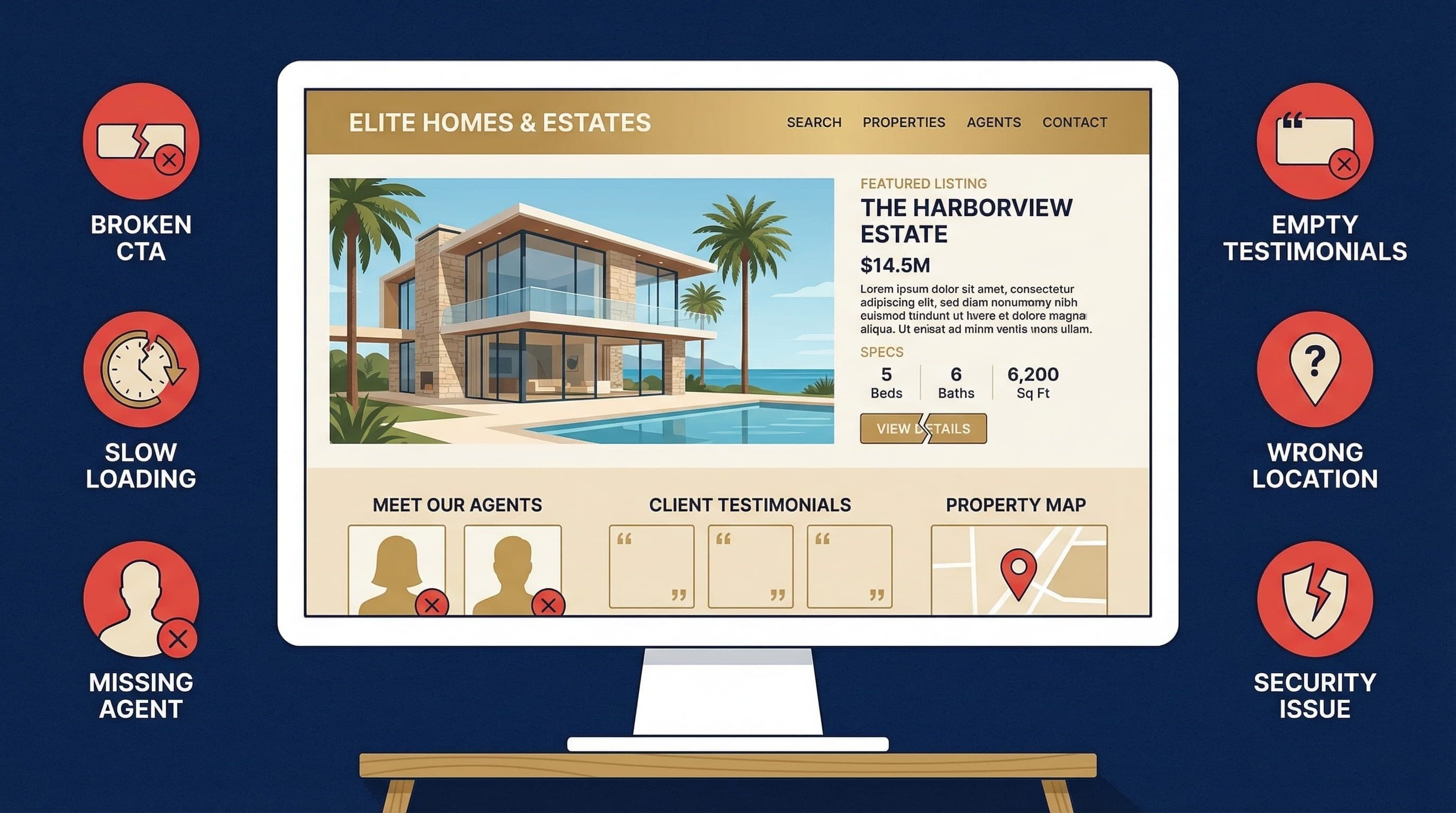
The luxury real estate market operates on first impressions. A high-net-worth buyer or seller evaluating agents does not distinguish between the quality of service an agent provides and the quality of the digital presence they present. A slow site signals disorganisation. A generic headline signals an agent who has not thought carefully about their positioning. A missing headshot signals a reluctance to stand behind the brand.
Most real estate websites are built for launch, not for performance. The developer delivers the site, the agent approves the design, and the site goes live. Six months later it has not generated a single qualified enquiry. The agent blames the market or the location, when the actual problem is that the site was never configured to convert visitors into leads.
The checklist below covers every element that a properly functioning luxury real estate site needs to have in place. It is not a design guide. It is an operational audit. Work through it on your existing site and address every item that is incomplete. If you are building a new site, use it as the specification before a developer writes a single line of code.
The items that most agents are missing fall into three predictable categories: conversion structure (no clear CTA, too much friction on the contact form), trust signals (generic or absent testimonials, no sold property examples), and local SEO (no area pages, no schema markup, inconsistent business information). Address these three categories and most real estate sites see measurable improvement in enquiry volume within 60 days.
Most agents I work with prefer having this checklist completed for them as part of a professional site build, so the site is configured correctly from day one rather than audited and patched after launch.
The 30-Point Luxury Real Estate Website Checklist
Work through this list in order. Each section addresses a different layer of site performance. Items marked Done can be revisited quarterly to confirm they remain current.
| # | Checklist Item | Category | Done? |
|---|---|---|---|
| 1 | Domain on a reputable registrar owned by the agent, not the developer | Foundation | [ ] |
| 2 | SSL certificate active — site loads on https:// | Foundation | [ ] |
| 3 | Hosting on managed WordPress plan with server-level security | Foundation | [ ] |
| 4 | WordPress core on latest version | Updates | [ ] |
| 5 | All plugins updated to latest version | Updates | [ ] |
| 6 | Unused plugins deleted, not just deactivated | Updates | [ ] |
| 7 | Homepage headline is specific to market and client type, not generic | Messaging | [ ] |
| 8 | Above-the-fold CTA visible without scrolling on desktop and mobile | Conversion | [ ] |
| 9 | CTA button text is specific: Book a Valuation, not Contact Us | Conversion | [ ] |
| 10 | Contact form has three fields maximum for initial enquiry | Conversion | [ ] |
| 11 | Phone number visible on every page, click-to-call on mobile | Conversion | [ ] |
| 12 | Response time expectation stated beside or below the contact form | Conversion | [ ] |
| 13 | Professional headshot of agent on homepage above the fold | Trust | [ ] |
| 14 | At least three named, specific client testimonials with outcomes | Trust | [ ] |
| 15 | Sold property examples with area, result, and timeframe | Trust | [ ] |
| 16 | Agent credentials, awards, and market experience stated clearly | Trust | [ ] |
| 17 | All property images compressed to under 200KB | Performance | [ ] |
| 18 | Page load time under three seconds on mobile (tested on GTmetrix) | Performance | [ ] |
| 19 | Caching plugin active and configured | Performance | [ ] |
| 20 | Images set to lazy load below the fold | Performance | [ ] |
| 21 | Dedicated area page for each location the agent actively serves | Local SEO | [ ] |
| 22 | Google Business Profile verified and linked to website | Local SEO | [ ] |
| 23 | LocalBusiness schema markup on homepage | Local SEO | [ ] |
| 24 | NAP consistent across site, Google Business, and any directories | Local SEO | [ ] |
| 25 | Title tags include location and property type on all key pages | Local SEO | [ ] |
| 26 | Security plugin installed and configured with Extended Protection firewall | Security | [ ] |
| 27 | Login hardened with 2FA and custom login URL | Security | [ ] |
| 28 | Daily automated backups to off-site storage active | Security | [ ] |
| 29 | Uptime monitoring active with SMS alerts | Security | [ ] |
| 30 | Google Analytics 4 with form submission and phone click goals tracked | Analytics | [ ] |
Section-by-Section Breakdown
Foundation — Domain, SSL, and Hosting
Domain ownership is the most overlooked item on this checklist and the most consequential. A real estate agent whose domain is registered in a developer's name has no ownership over their digital presence. If the relationship ends, access to the domain is at the developer's discretion. Always register the domain in your own name through a reputable registrar such as Namecheap or GoDaddy, with your own email address as the account contact.
SSL and hosting quality are the infrastructure everything else builds on. A slow host produces a slow site regardless of how optimised the code is. Managed WordPress hosting at $15 to $25 per month provides server-level security, better speed, and isolation from other accounts that budget shared hosting cannot match.
Pro Insight:
Before working with any developer, confirm in writing that the domain will be registered in your name and that all hosting account credentials will be provided to you at handover. This protects against the most common and most costly dependency trap in the web development market.
Messaging — What the Site Actually Says
The homepage headline is the highest-value piece of copy on the entire site. Most luxury real estate headlines read as welcome messages or vague authority claims. A headline that names the specific market, client type, and outcome the agent delivers is worth more than any design element on the page. 'Luxury Property Sales in Prime Central London for Discerning International Buyers' tells a visitor in one sentence whether they have found the right agent. A generic welcome message tells them nothing.
Pro Insight:
Specificity in the headline does not narrow the audience in a damaging way. It attracts the right clients and signals expertise to everyone. A vague headline signals an agent who has not made a clear choice about who they serve. A specific headline signals authority and confidence, which is exactly what a high-net-worth client is evaluating.
Conversion — Turning Visitors Into Enquiries
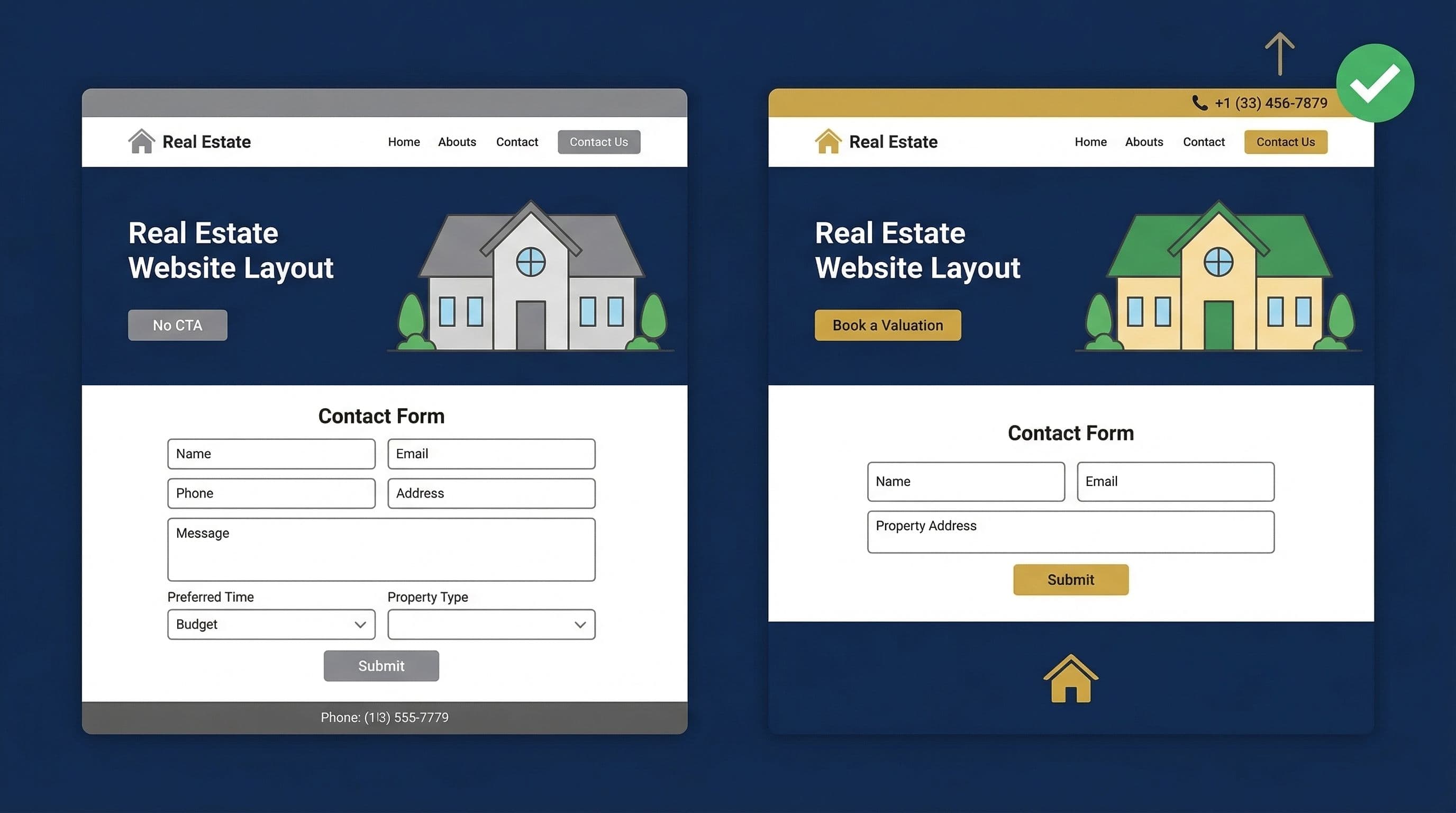
The six conversion items in the checklist address the specific friction points that prevent visitors from making contact. The most impactful single change on most real estate sites is adding a specific, visible CTA above the fold. Not a contact link in the navigation. A button with a specific outcome on the page itself, visible without scrolling, on every page of the site.
Contact form length is the second most common conversion killer. A form asking for name, email, phone, property address, estimated value, preferred viewing time, and how the visitor heard about the agent is not a lead capture form. It is a qualification questionnaire. The goal of the form is to start a conversation. Reduce it to three fields and let the conversation do the qualification.
Pro Insight:
The response time expectation is a small addition that meaningfully reduces the anxiety that prevents some high-value clients from submitting a form. Stating 'We respond within one business hour during working hours' beside the submit button signals professionalism and reduces the perceived risk of making contact.
Trust — Why High-Net-Worth Clients Need More Proof

Trust signals for luxury real estate are not equivalent to trust signals for a general service business. Generic five-star review summaries from aggregator platforms carry minimal weight with a client considering entrusting an agent with a multi-million-pound property sale. Specific, named testimonials with verifiable outcomes and a professional headshot of the agent carry significant weight.
Sold property examples are the most powerful trust signal available to a real estate agent and the one most consistently absent from agent websites. An example that shows the listing price, the sale result relative to asking price, and the timeframe to sale demonstrates competence in a way that no amount of general credibility copy can match.
Pro Insight:
Three specific testimonials with named clients, identified areas, and stated outcomes outperform twenty generic review summaries. When requesting testimonials from past clients, ask them to describe the specific result: what the property was, what the outcome was, and how quickly it was achieved. The specificity is what creates credibility.
Performance — Speed in a Market Where Impressions Matter
A slow luxury real estate site creates a specific and damaging contradiction: the agent is presenting themselves as premium while delivering a substandard experience. A client who waits five seconds for a page to load on their phone has already formed an impression before seeing a single property photo. That impression is not premium.
Property photography is the largest performance variable on most real estate sites. A single uncompressed hero image can exceed 4MB. Compressing all property images to under 200KB before upload, enabling lazy loading below the fold, and activating a caching plugin on quality managed hosting reduces most real estate sites from 5 to 8 second load times to under 2.5 seconds without touching the design.
Pro Insight:
Test load speed on an actual mobile phone using GTmetrix, not the desktop browser's mobile preview. The desktop emulation does not replicate real mobile network conditions. A site testing at 2 seconds on desktop emulation may test at 4.5 seconds on an actual mobile device on a 4G connection.
Local SEO — Getting Found by the Right Searchers
The majority of high-value real estate search queries include a location. A site without dedicated area pages is structurally unable to rank for these queries regardless of the homepage's quality. Area pages work when they contain genuinely local content: current market conditions in that area, typical property types, the agent's specific experience there, and recent comparable examples. A page that inserts a location name into a generic agency description is not a functional area page.
Schema markup is the most consistently skipped technical SEO item on real estate sites. Adding LocalBusiness schema to the homepage takes 20 minutes and communicates the agent's geographic service area directly to search engines in a structured format. Combined with a complete and verified Google Business Profile, it significantly improves visibility in local search results.
Pro Insight:
NAP consistency — name, address, phone number — must be identical across the website, Google Business Profile, and every directory listing. A discrepancy as minor as 'St' versus 'Street' in the address creates a signal conflict that reduces local search authority. Audit every directory listing when updating contact information.
Security — Protecting the Brand and the Data
A hacked luxury real estate site has consequences beyond the technical inconvenience. A site showing malware warnings or pharmaceutical spam to potential clients creates reputational damage in a market where brand trust is the primary competitive asset. Security on a luxury real estate site is not a technical concern. It is a brand protection concern.
The four security items in the checklist: a configured security plugin with Extended Protection firewall, login hardening with 2FA, daily off-site backups, and uptime monitoring, address the most common attack vectors and ensure rapid recovery if an incident does occur. All four are achievable in under two hours and require no ongoing attention once configured correctly.
Pro Insight:
Uptime monitoring catches redirect hacks that have no visible symptoms from the agent's perspective. If malware redirects new visitors to a spam destination while the site appears normal to logged-in admins, the agent may be unaware for days. Monitoring tools detect the redirect within minutes and alert immediately.
Analytics — Knowing What Is Actually Working
Google Analytics 4 with goal tracking configured is the difference between knowing the site is generating enquiries and assuming it is. Most real estate sites have Analytics installed but have never configured goals. Pageview data tells the agent how many people visited. Goal tracking tells them how many enquired, which pages drove the enquiries, and which traffic sources are producing actual leads versus passive visitors.
Pro Insight:
Configure goals for three events at minimum: contact form submission confirmation page view, phone number click on mobile, and any PDF download such as a market report or area guide. These three goals give a real picture of site engagement beyond page views and session duration.
Common Mistakes That Cost Agents Listings
Launching Before the Checklist Is Complete
A site launched with incomplete conversion structure, missing trust signals, and no local SEO foundation starts working against the agent immediately. Every visitor who arrives and finds no clear CTA, no specific testimonials, or a five-second load time is a potential enquiry lost to a competitor whose site passes the same evaluation. The checklist is not a post-launch audit. It is a pre-launch specification.
Delegating Domain and Hosting Ownership to the Developer
This single mistake creates more long-term problems for real estate agents than any technical issue. An agent whose developer holds the domain registration, the hosting account, or both is dependent on that developer for continuity. When the relationship ends, access to the site may be contested. Transferring a domain held by a developer who is unresponsive or unwilling can take weeks and cost more than the original site build. Own the domain and the hosting account from day one.
Using Generic Testimonials
'Great service, very professional' is on every competitor's site. It provides no differentiation and carries no specific weight with a sophisticated buyer or seller evaluating multiple agents. Specific testimonials that name the outcome, the location, and the timeframe create credibility that generic praise cannot. The effort required to obtain specific testimonials is minimal. The impact on conversion is significant.
No Area Pages for Primary Markets
An agent who primarily serves three or four specific areas and has no dedicated pages for those areas is invisible in local search for their core market. Generic homepage SEO does not substitute for area-specific pages. A buyer searching for luxury agents in a specific neighbourhood will find the agents whose sites have dedicated pages for that neighbourhood. An agent without those pages is simply not in that conversation.
How Often Should This Checklist Be Reviewed?

The foundation, security, and analytics items are one-time configurations that should be verified quarterly. The messaging, conversion, and trust items should be reviewed every six months as market conditions, sold inventory, and client testimonials accumulate. The performance and local SEO items should be checked after any significant plugin update or site change that could affect load speed or page structure.
A practical approach: block two hours twice a year for a full site audit using this checklist. That investment, four hours of focused attention annually, maintains the site as a functioning lead generation asset rather than letting it drift into the category of outdated, underperforming digital presence that most agents eventually have to rebuild.
Don't Have Time to Deal With This?
Thirty checklist items across eight categories is a comprehensive picture of what a luxury real estate site needs. It is also a significant amount of work to complete correctly if the site was not built with these elements in mind from the start.
The $449 WordPress Website Package is for agents and service business owners who want a site built to this specification from day one. Every item on this checklist is addressed before the site goes live. Domain registered in your name. Conversion structure in place. Trust signals positioned correctly. Area pages built. Security configured. Analytics tracking goals.
One fixed price. No agency overhead. No retainer required.
[ View the $449 WordPress Website Package ]
About the Author
Sheikh Hassaan — WordPress Developer for Small Businesses
I help service businesses launch fast, secure, conversion-focused WordPress websites without the agency price tag. I've built sites for coaches, consultants, local service providers, and founders who need something professional that actually works — not a DIY project that becomes a second job.
Related Articles
- Your Real Estate Website Is Not Getting Leads. Here Is Exactly What to Fix.
- The Best WordPress Theme for Luxury Real Estate Websites (2026 Comparison)
- 7 Signs Your Real Estate Website Is Losing You Listings
Frequently Asked Questions
What should a luxury real estate website include?
A luxury real estate website needs a specific above-fold CTA, professional agent headshot, named testimonials with outcomes, sold property examples, dedicated area pages for each target market, compressed property images for fast load speed, 2FA login security, daily backups, and Google Analytics with goal tracking configured. Generic design without these conversion and trust elements will not generate enquiries from high-net-worth clients.
How do I make my real estate website generate more leads?
Start with three specific changes: make the CTA button visible without scrolling on every page with specific text like Book a Free Valuation, reduce the contact form to three fields, and add at least three named testimonials with specific outcomes. These three changes produce the fastest improvement in enquiry volume without requiring a redesign.
Do real estate agents need area pages on their website?
Yes. Most high-value property search queries include a location, and a site without dedicated area pages cannot rank for those searches. Each area page should contain genuine local content including market conditions, property types, and the agent's specific experience in that area, not just a generic description with a location name inserted.
How fast should a luxury real estate website load?
Under three seconds on mobile is the target. A one-second delay in mobile load time reduces conversions by approximately 20 percent. Most real estate sites are slow because property images are uploaded without compression. Reducing all images to under 200KB and enabling lazy loading typically brings load time under two seconds without changing the design.
Should I own my real estate website domain myself?
Yes, always. Register the domain in your own name through a reputable registrar and keep the account credentials yourself. A domain registered in a developer's name creates a dependency that can become costly and difficult to resolve if the relationship ends. This applies to hosting accounts as well.